


From Last Resort to First Response: The Evolution of Fire Suppression in the Pulp and Paper Industry

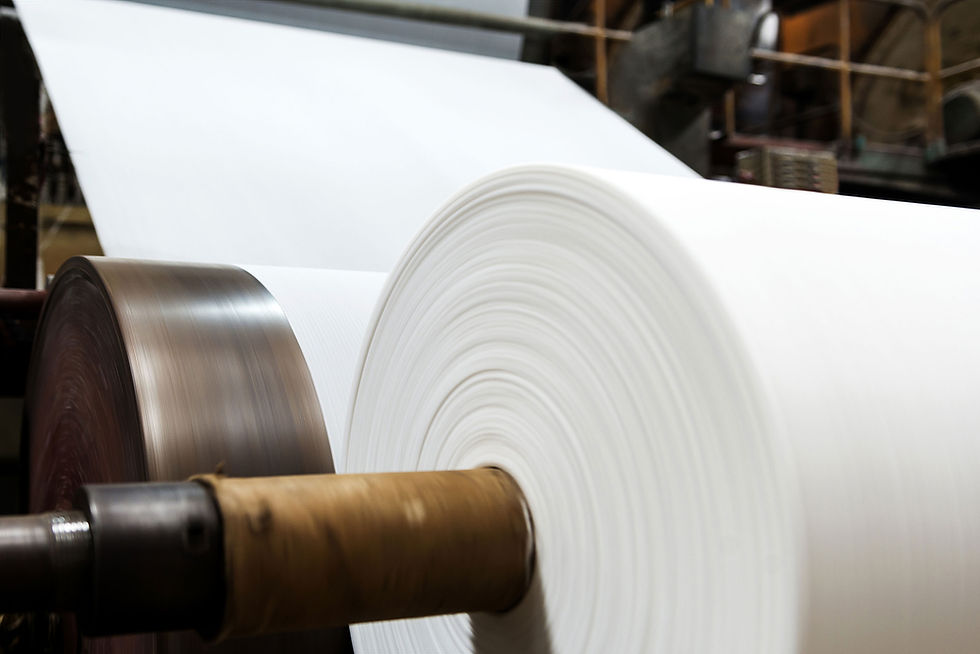
This article explores the evolution of fire suppression in the pulp and paper industry, from traditional reactive systems like wet-pipe sprinklers to advanced autonomous and predictive technologies that integrate sensors, analytics, and robotics for earlier, targeted intervention. Key topics include the industry's inherent fire hazards—such as combustible dust, high-heat processes like Yankee dryers, and storage risks in chip piles and roll areas—the historical need for robust protection in mills, the mechanics and limitations of traditional sprinkler systems, principles of targeted fire suppression using thermal or IR3 monitoring, and a comparative analysis emphasizing layered defenses to minimize downtime and opportunity costs from broad water discharge.
The Pulp and Paper Industry: A Cornerstone of Manufacturing.
The pulp and paper industry remains one of the most established and vital sectors in manufacturing. It underpins everything from corrugated packaging essential for supply chains to tissue and hygiene products integral to daily life. The production process—debarking and chipping, pulping, refining, sheet forming, pressing, drying, and high-speed calendering and reeling—represents a symphony of industrial engineering. Yet, it’s also an environment where fire risk is structurally “built in”: high volumes of combustible fiber, continuous motion, high heat, and complex utilities. And loss prevention organizations consistently flag pulp and paper as a multi-hazard environment—FM Global’s loss record points to major hazard areas including log/chip piles, black liquor recovery boilers, paper machines, roll paper storage, and process control centers/wiring, among others. FM
Fire risk snapshot (industrial manufacturing context). To put the broader industrial picture in perspective, NFPA research estimates that U.S. fire departments respond to an annual average of 36,784 fires at industrial/manufacturing properties (2017–2021), with roughly $1.5B in direct property damage. Within that, structure fires alone average 8,077 per year, associated with 155 civilian injuries and $988M in direct property damage.
Why Mills Burn “Differently”: Fuel + Heat + Continuity.
In pulp and paper, fire doesn’t just threaten people, buildings and assets, it threatens continuous production. The same conditions that enable efficiency also enable rapid escalation: fuel everywhere in the form of wood chips, recycled fiber, dry pulp, paper webs, and roll storage; heat everywhere from dryers, steam systems, and friction heat from high-speed rollers and bearings; ignition sources everywhere such as mechanical failures, electrical distribution, hot work, and overheated components; and dust everywhere, with fiber and paper dust layers that can accumulate on hoots, equipment, cable trays, structural components and conveyor structures—turning small ignition events into fast-spreading incidents.
Besides being a housekeeping issue, paper fiber and dust is an ignition multiplier and, in the right conditions, a fire accelerator. OSHA’s guidance on combustible dust notes that dust fires have repeatedly caused catastrophic incidents, citing a CSB tally of 281 combustible dust incidents (1980–2005) resulting in 119 fatalities and 718 injuries. OSHA’s Revised Combustible Dust National Emphasis Program (NEP) explicitly includes paper among combustible organic dusts, and it exists because these hazards are both common and consequential. The same OSHA directive reports that in FY 2013–2017, OSHA conducted 2,553 combustible dust inspections and identified 3,389 violations—an enforcement signal that these controls are routinely missed or underbuilt.
Historical Issues with Fire and the Imperative for Suppression.
Since the inception of mechanized paper mills, fire has posed an existential threat—especially in and around paper machines, drying sections including Yankee dryers, and storage. What makes the modern mill distinct is speed: high airflow, continuous web movement, and abundant combustibles can move a small ignition event into a major incident quickly. Loss prevention experience also highlights that mill risk isn’t confined to one production floor, raw material storage and even finished products include high risks.
Traditional Technology: Wet-Pipe Sprinkler Systems--Proven, but Slow and Reactive.
For over a century, wet-pipe sprinkler systems have served as the benchmark for industrial fire protection. They remain foundational because they are reliable and scalable, especially for protecting broad hazard areas. But a sprinkler system is only as dependable as its ongoing upkeep, and may not be suitable for fast spreading fires.
How wet-pipe works:
Wet systems activate when a sprinkler element reaches its set temperature and releases water in a broad pattern. This is excellent for containing developed fires, but it’s inherently post-escalation: activation requires significant heat buildup at the head. In process-dense environments, that means larger thermal development and often wider water application than the actual seat of the fire.
The Principles of Autonomous Fire Suppression: Precision Intervention.
Contemporary autonomous suppression systems aim to intervene earlier with a targeted approach. Rather than waiting for ceiling-level heat to build, these systems use sensing (often IR/thermal) and automated actuation to detect a threat and place suppression at the threat. This approach maps directly to NFPA’s broader industrial experience: if equipment/heat-source failure and mechanical malfunction are common ignition pathways, then fast detection plus targeted cooling/suppression around machines and conveyors is a logical evolution. Typical architecture includes thermal/IR3 detection, analytics (thresholding, trend detection, confirmation), directed discharge with a robotic monitor, and integration with alarms and response playbooks. There are two main monitoring sensors, thermal or IR3, and each has a place. In ordinarily high heat areas, a thermal might not be best, in which case an IR3 sensor would be recommended, and in areas like storage or chip piles, thermal imaging would be preferred to detect heat buildup.
A major advantage of continuous thermal monitoring is trend visibility: abnormal heat rise on bearings, motors, rolls, or electrical components often appears before open flame. In dust-laden, fiber-rich environments, early intervention can mean the difference between a quick stoppage and a cascading event. Autonomous suppresion systems can detect the abnormal heat or flames within 4 seconds, and be actively suppressing the fire in 10 seconds after ignitan. This is the philosophical shift: legacy sprinklers defend the structure after the fire has meaningfully developed and spread, while predictive / autonomous suppression initiates before fire becomes a runaway incident.
An Objective Analysis: Layered Defense Wins.
Wet-pipe sprinklers remain essential for broad-area protection, and they’re reliable for preventing total loss. But mills are also high-value, moisture-sensitive environments: broad water application can damage reels, controls, MCCs, VFDs, and instrumentation—sometimes rivaling the fire’s direct cost. Autonomous systems don’t “replace” sprinklers so much as tighten the response window and reduce collateral impact by focusing suppression where it matters most—especially around paper machines, conveyors, roll handling, and electrical/process control areas.
Practical Takeaways for Mill Operators. Treat mechanical reliability as fire prevention, since many industrial ignitions trace back to equipment/heat-source failures and mechanical malfunction patterns, as per NFPA. Treat dust as a fire-and-explosion hazard, not a cosmetic issue, given that OSHA and CSB data show combustible dust incidents can be catastrophic. Protect what actually drives downtime: machines, conveyors, roll storage, and controls—exactly where loss-prevention history concentrates risk, according to FM. Use layered protection: broad sprinklers plus targeted, autonomous suppression.
Exploring Modern Solutions? For pulp and paper facilities seeking faster, more precise intervention in high-risk process areas, targeted fire suppression can be a practical step toward proactive risk mitigation, especially where dust accumulation, continuous operation, and high, speed machinery compress the time between “hot spot” and “full incident.”


Comments