


Early Fire Detection
The Best Way to Fight a Big Fire?
Don't Let It
Become One.

WatchDog Robotics provides advanced early fire detection using thermal imaging, triple-infrared flame detectors, and a combination of technologies to identify hot spots and small flames in seconds, not minutes. By catching ignition events at the earliest possible moment, our systems keep high-risk environments operational, high-value assets protected, and your people out of harm's way.
Ready to go?
Thermal Imaging:
Detect Heat Before Flames Appear
Every object radiates infrared energy in proportion to its temperature. A thermal imaging camera reads that energy and turns your facility into a live temperature map, where a developing problem shows up as a bright spot long before anyone could see, smell, or feel it.
Timing is Everything.
That head start matters because many industrial fires don't begin with an open flame. They begin with heat: a smoldering pocket deep in a storage pile, an overheating bearing or motor, a cell in thermal runaway. Thermal imaging watches for exactly this pre-combustion stage, the window where intervention is easiest and damage is lowest.
How we use it.
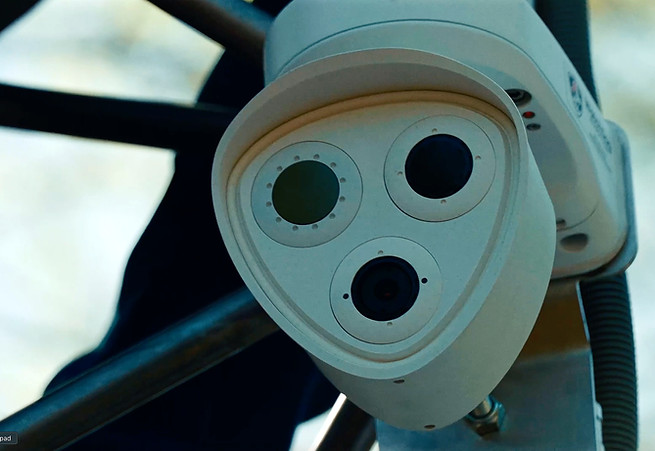
WatchDog deploys radiometric thermal cameras that measure an actual temperature at every pixel, not just relative brightness. That allows precise alarm thresholds to be set, and monitored zones for your site: flag anything on the conveyor above a set temperature, watch a storage bay for a rising hotspot, keep eyes on an electrical room around the clock. Because thermal imaging works in total darkness and sees through airborne dust and light smoke, it holds up in the conditions where conventional detection struggles.
Thermal monitoring is a natural fit for conveyor lines, bulk and pile storage, waste and recycling, paper and wood processing, battery and EV facilities, and electrical infrastructure. Anywhere where self-heating or temperature anomalies are the first sign of fire.

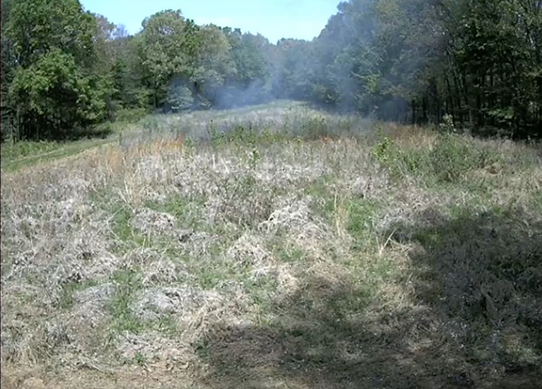
Infrared Flame Detection:
Confirm Real Fires, Fast.
Multi-spectrum infrared flame detection looks for the exact infrared fingerprint of an open flame, and that is what makes it both far-reaching and hard to fool.
How IR3 works.
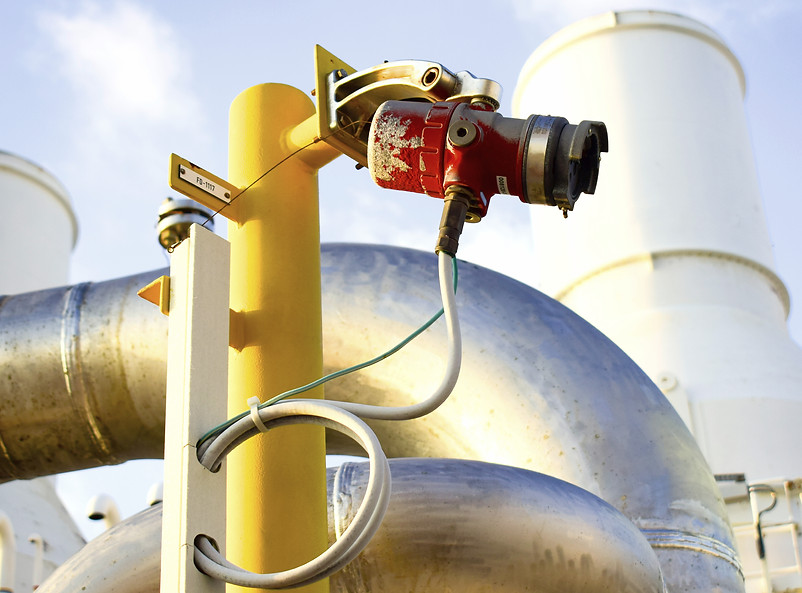
A triple-infrared (IR3) detector watches three separate infrared wavelength bands at once. One is centered near the 4.3-micron band, where burning hydrocarbons release a strong burst of energy as they produce carbon dioxide. The detector continuously compares the ratio between its three bands and cross-checks it against flame flicker — the characteristic 1-to-15-hertz pulsing of real fire. A hot machine, a welding arc, reflected sunlight, or a blackbody heat source might trip a different sensor; almost none of them reproduce that spectral ratio and that flicker signature together. The payoff is long detection range — a small hydrocarbon fire spotted clear across a large bay — paired with an extremely low false-alarm rate, even outdoors and in bright, changing light.
What Quad IR adds.
A four-band (Quad IR / multi-IR) detector adds a fourth sensing wavelength. That widens the range of fuels it can recognize, extends coverage to some fires that are harder to see in three bands, and hardens the detector even further against nuisance sources. Where a site has demanding lighting, mixed fuels, or a very low tolerance for false trips, the extra band earns its place.
How we use it.
IR is central to how NozzleBot™ decides to act. Before a single drop is released, the system confirms an actual flame rather than a false signal. Paired with a second detector, IR triangulates the fire's position in three-dimensional space, so suppression is aimed at the source instead of indiscriminately soaking the whole area.
IR flame detection excels in environments with high or variable background heat. Welding, cutting, hot engine surfaces, and other transient heat sources routinely false-trigger thermal cameras, which register anything hot as a threat. Multi-spectrum IR detectors reject those signals by design. The result is fast, high-confidence flame detection.
Smart Video Analytics & More
Different fires announce themselves in different ways. Two additional technologies round out how WatchDog detects them.
UV/IR Flame Detection
At the instant of ignition, a flame emits a burst of ultraviolet radiation — one of the fastest fire signals there is, often registering within milliseconds. UV/IR flame detectors combine an ultraviolet sensor with an infrared one and require both to agree before raising an alarm.
That pairing exists because each sensor covers the other's weakness. A UV sensor is blindingly fast but can be tricked by arc welding, lightning, or X-rays, and it can be blinded by heavy smoke or an oily film on the lens. The infrared side ignores those false triggers and sees through smoke. Together they deliver UV's speed with IR's reliability, which makes UV/IR well suited to fast, high-energy hydrocarbon and hydrogen fires in fuel handling, petrochemical operations, and hangars.
Video Smoke & Flame Analytics
Standard and specialized cameras, run through computer-vision algorithms, can recognize fire by sight. Video smoke detection reads the motion, texture, and spread of a rising plume; video flame detection reads the color, flicker, and pattern of open flame.
Because the camera watches an entire scene, video analytics catch smoke at its source in large, open, and high-ceiling spaces (warehouses, atria, tunnels, hangars, and mill floors) where smoke or heat would take far too long to travel up to a ceiling-mounted spot detector. And every alarm arrives with video, so the event can be visually verified in seconds and pinpointed in the frame. No guessing which sensor tripped, no walking the floor to find out what's happening.

Smart Video Analytics & More
One Fire, Multiple Confirmations: Layered Detection for Speed and Certainty
No single method is best at everything, and that's the point. Thermal imaging catches heat before there's a flame. IR3 and Quad IR confirm a real flame at long range. UV/IR registers ignition in milliseconds. Video analytics cover wide-open spaces and verify what's happening on screen. Each one sees clearly where another has a blind spot.
WatchDog matches these methods to your site — the fuels present, the layout and ceiling heights, the lighting, and the everyday sources of false alarms like welding, sunlight, steam, and dust. Then we let them work together. When two independent methods have to agree before the system acts, you get high sensitivity and a very low false-alarm rate at the same time — the two things that normally trade off against each other.


Get a Price!
For immediate service, call or text (307) 231-0416.
