


Temporary Fire Suppression During Sprinkler Impairments: A Better Alternative to Fire Watch
- Ethan Pretsch

- 10 hours ago
- 7 min read
Buildings lose sprinkler protection all the time, for a range of reasons. Whatever the cause, the situation ends up the same: for weeks or months, nothing in the building automatically puts water on a fire. The standard response for decades has been a 24-hour fire watch. WatchDog Robotics offers another option.

Why buildings lose sprinkler protection
In some cases the system is being replaced. In others, construction has outpaced fire protection installation, or a temporary structure was never designed for sprinklers in the first place. Whatever the reason, the building is left with no automatic fire suppression, and code requires something to fill the gap.
Temporary fire suppression fills it. It is an automatic detection and suppression system deployed for a defined period, whether that is a sprinkler outage, a construction phase, or a structure's lease term. It detects a fire and puts water on it with no one present. The WatchDog NozzleBot Defender is a trailer-mounted version of this. It tows to site behind a pickup, deploys in under 90 minutes, and runs continuously until the permanent system is back online. Below, we cover when it applies, what it costs compared to a fire watch, and how to present it to your Authority Having Jurisdiction.
Three ways the gap opens
1. Sprinkler replacement and system outage
This covers aging CPVC swap-outs, corrosion-driven wet pipe overhauls, seismic retrofits, and tenant reconfigurations that reroute mains. In each case the branch lines are open, drained, or gone. NFPA 25 Chapter 15 sets the requirement: once a water-based system is out of service for more than 10 hours in any 24-hour period, the impairment coordinator has to notify the AHJ and either restore the system or establish a fire watch. For a contractor rebuilding a riser, that requirement stays in force for the full duration of the work.
2. Construction ahead of fire protection installation
NFPA 241 calls for fire protection to be brought into service as construction progresses, as soon as practicable. On an active job site, that is difficult to achieve. Combustible construction, temporary heat, and hot work start generating meaningful fire load well before the permanent system is charged and accepted, which leaves a window, often months long, where the building is exposed. See construction fire safety applications.
3. Structures never designed for sprinklers
Clearspan tents used for personnel assembly, hot work enclosures, bulk storage, and interim warehousing are built to be put up, used, and taken down. Installing a code-designed sprinkler grid inside a relocatable structure is often impractical, sometimes physically impossible, and almost always disrupts the schedule that justified using the structure in the first place. See temporary and fabric structures.
What a fire watch can and cannot do
A fire watch is not fire protection. It is the code's way of acknowledging that protection is absent, and it places a person on site until protection returns. That person can watch for fire but cannot suppress it. When they find one, the response runs from notification to fire department travel and setup, typically five to fifteen minutes or more from the alarm. Fire load during that window can climb fast; under the right conditions a fire can double in size every 10 to 60 seconds. And between rounds, a single guard covers nothing.
The economics of continuous fire watch
Around-the-clock fire watch coverage is often one of the largest unplanned expenses of a sprinkler impairment, and it is rarely in the original project budget. The math adds up quickly. Continuous coverage is about 720 hours per month. At published 2026 U.S. metro rates of $30 to $55 per hour per guard, a single post costs roughly $21,600 to $39,600 per month, and that is before relief coverage, overtime, or the extra guards a larger area requires. A six-month sprinkler replacement can run into six figures of labor that delivers no suppression capability at all.
Temporary fire suppression is priced differently. A Defender deployment is a fixed weekly or monthly rental. It does not scale with headcount, shift differentials, or schedule overruns. On many projects that fixed cost comes in at less than half the price of a continuous fire watch, and it provides what a fire watch cannot: automatic detection and automatic suppression.
What temporary fire suppression must replace
A sprinkler system performs four basic functions: it senses that a fire has started, determines where the water should go, delivers that water at sufficient density, and does all of it with no one present. Any temporary protection has to cover the same four functions to count as protection.
Fire watch vs. NozzleBot Defender: decision matrix
Capability | Fire Watch | NozzleBot Defender |
Detects fire | Yes | Yes |
Automatically suppresses fire | No | Yes |
Continuous monitoring | Partial, between rounds | Continuous, all covered zones |
Requires on-site personnel | Yes, 24/7 with relief | No |
Recurring cost structure | High monthly labor | Fixed weekly or monthly rental |
Works without sprinkler piping | No | Yes |
Auditable activity record | Manual log sheet | System status log, remotely monitorable |
Time to water on fire | 5 to 15+ minutes via fire department | About 15 seconds |
How the NozzleBot Defender works
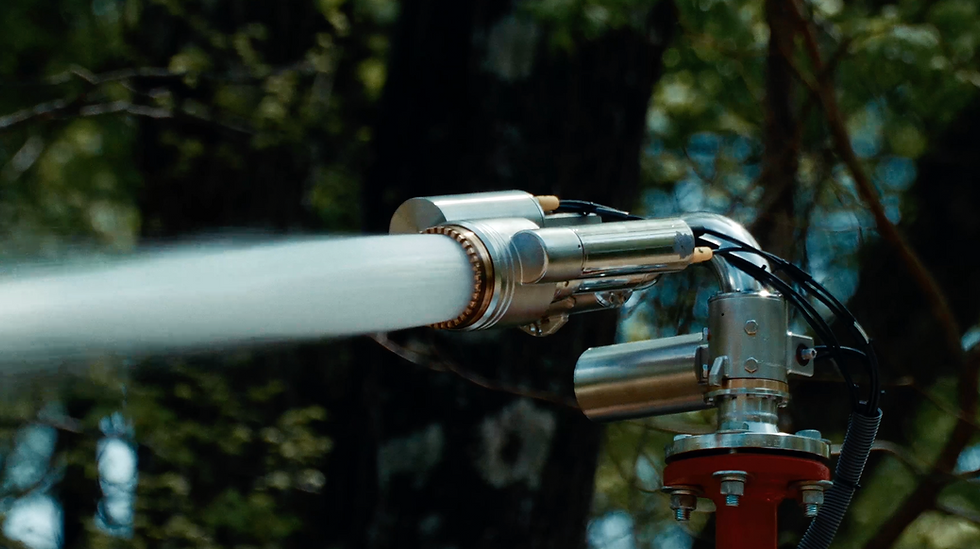
The Defender is the trailer-mounted, rapidly deployable configuration of the NozzleBot robotic fire monitor platform (ARFSS, or Autonomous Robotic Fire Suppression System). It arrives behind a pickup, sets up truss-mounted sensor towers, and begins scanning, all in under 90 minutes with a two-person crew.
Detection uses triple-infrared (IR3) sensors combined with thermal video analytics, cross-validating the inputs to confirm a real fire and locate it in three-dimensional space before acting. The monitor then aims, selects a spray pattern based on distance, and opens the valve. Water reaches the seat of the fire within 15 seconds of detection.
A few things matter in temporary applications specifically. The Defender carries its own hydraulics, with the pump and discharge device built as a single package, so there is no makeshift field connection to a distribution network that is half-disassembled or missing. It also shuts off on its own once the fire is out and returns to monitoring, which is important in an occupied building mid-retrofit or a temporary warehouse full of staged product, where an overrun activation can cost more than the fire itself. And when the job is done it leaves nothing behind: no hangers, no mains, no penetrations in a fabric envelope, no demolition at closeout.
Why this is a rental conversation, not a capital one
Temporary risk is time-limited. A sprinkler replacement has a schedule, a construction phase has its milestones, and a fabric structure has a lease term. The Defender is available on weekly and monthly rental terms throughout the United States, so the protection is scoped to the same timeline as the exposure. That makes it easier to budget, to justify, and to close out.
What each stakeholder needs to know
Role | What matters to you |
Plant Engineer | Automatic suppression covers the facility for the full impairment, not just observation between rounds, with automatic shutoff limiting water damage to process equipment and inventory. |
AHJ / Plan Reviewer | A compensating measure that performs detection, targeting, and suppression, with FM 4-14 as documented technical backing for the architecture. |
FM Global Risk Engineer | Materially reduced exposure during the impairment window, using a system architecture FM formally addressed in April 2026. |
General Contractor | Protection that deploys in 90 minutes and does not depend on the permanent system's schedule, so fire protection stops being the critical path. |
Facility Manager | A fixed rental in place of open-ended 24/7 labor that scales with every schedule slip. |
Fire Protection Contractor | A bridge that covers the building while you rebuild the sprinkler system, and a defensible answer when the owner asks what protects the space in the meantime. |
Frequently asked questions
What is temporary fire suppression?
An automatic detection and suppression system deployed for a defined period to protect a building or site with no functioning sprinkler system. Unlike a fire watch, which only observes, it detects a fire and applies water to it automatically.
When is a fire watch required during a sprinkler impairment?
Under NFPA 25 Chapter 15, when a water-based system is out of service more than 10 hours in any 24-hour period, the impairment coordinator must notify the AHJ and either restore the system or implement a fire watch. Specific thresholds are set by the AHJ.
Can temporary fire suppression replace a fire watch?
Yes. An AHJ can allow an ARFSS such as WatchDog's Defender NozzleBot in lieu of a fire watch. It gives the AHJ a compensating measure that performs detection, targeting, and suppression, which a fire watch cannot do, and that is the basis on which the substitution is approved.
How fast can a temporary fire suppression system be deployed?
The trailer-mounted Defender is towed to site behind a pickup and deploys in under 90 minutes with a two-person crew, including the sensor towers and the robotic monitor.
How is this different from renting a temporary fire pump?
A rented fire pump is a pressure source that requires intact sprinkler piping downstream, and it cannot detect a fire or decide where water goes. WatchDog provides the pump, the detection, and the robotic nozzle as one package, so it works where no piping exists.
Does it work in buildings with no sprinkler piping at all?
Yes. An ARFSS such as the NozzleBot Defender does not depend on existing sprinkler infrastructure, which is why it is used on construction sites ahead of permanent system installation and inside fabric structures never designed for sprinklers.
How fast does it respond to a fire?
NozzleBot systems detect using triple-infrared (IR3) sensors with thermal video analytics and apply water within about 15 seconds of detection. The Defender reliably detects flames as small as 8 inches.
What standards support autonomous fire suppression?
FM Approvals Data Sheet 4-14, published April 2026, formally addresses automatic fire suppression systems and provides a documented technical basis for ARFSS evaluation, paired with FM Standard FS 8-22 for hardware qualification.
Does it cause water damage like a sprinkler activation?
Significantly less. An ARFSS targets the seat of the fire rather than flooding a broad area, and it shuts off automatically once the fire is out and then resumes monitoring. Conventional systems keep discharging water long after the fire is extinguished, and the resulting damage can be worse than the fire itself.
Is temporary fire suppression available as a rental?
Yes. WatchDog offers the Defender on weekly and monthly rental terms throughout the United States, matching the duration of the exposure it covers.
Don't Let a Temporary Fire Protection Gap Become a Permanent Loss
Whether you're replacing sprinkler piping, building a new facility, protecting a temporary structure, or responding to an unexpected impairment, the risk is the same. Fire doesn't wait for a construction schedule. The WatchDog Defender provides autonomous detection and suppression in a rapidly deployable rental package built specifically for temporary protection. Our engineers can evaluate your site, help prepare documentation for AHJ review, and recommend a deployment sized to your project.
Weekly and monthly rentals available throughout the United States
info@WatchDogRobotics.com · (307) 231-0416


Comments