


The Gap Between Ignition and Suppression—When Sprinklers Are Not Enough

The Ontario warehouse fire and the response gap conventional systems cannot close
At approximately 12:30 a.m. on April 7, 2026, an employee walked through a 1.2 million-square-foot Kimberly-Clark distribution center in Ontario, California and systematically lit pallets of paper products with a lighter. He filmed himself doing it. By morning, the building was gone.
The facility served roughly 50 million consumers across the region. Federal prosecutors have charged the suspect, 29-year-old Chamel Abdulkarim, with arson of a building used in interstate commerce. The estimated loss: approximately $500 million. The building had an active sprinkler system. It did not matter. Fire officials reported that the blaze grew "exponentially very quickly," overwhelming the suppression infrastructure and forcing 175 firefighters into a defensive, exterior-only posture. The roof collapsed. Total loss.
This outcome is worth examining carefully, not because it is unusual, but because it is not. Large warehouse fires with active sprinkler systems routinely end in total loss when fire load is high and ignition is fast. Ontario is a high-profile illustration of a structural gap in how large distribution facilities approach fire protection.
How a Fully Sprinklered Building Burns to the Ground
Traditional wet-pipe sprinkler systems are heat-activated. Each sprinkler head contains a glass bulb or fusible link that must reach 135 to 165 degrees Fahrenheit before water releases. That heat must accumulate at ceiling level. In a standard commercial setting, this process takes two to five minutes from initial ignition under favorable conditions.
Two to five minutes is consequential when the fuel load is high and ignition is intentional at multiple points. Under the right conditions, fire doubles in size every 10 to 60 seconds. Paper products, plastic wrapping, and wooden pallets represent exactly the fuel load that accelerates that growth curve. By the time sprinkler heads begin activating, a fire that started on a single pallet may already span multiple pallet rows and generate enough heat to defeat ceiling-level water discharge.
Individual sprinkler heads discharge at relatively low flow rates across a wide area, producing something closer to heavy rainfall than targeted suppression. When a fire is growing rapidly across a large floor area, the aggregate water density at the fire's base is often insufficient to achieve knockdown, even with several heads activated simultaneously.
The fire grew exponentially very quickly, forcing 175 firefighters into a defensive, exterior-only operation. Eight hours. Total loss.
This is consistent with what industry data shows. A 2022 Gen Re analysis of large warehouse fires found that in each case reviewed, sprinkler systems were installed but produced either significant damage or total loss. The common factors: high fire load, large unsubdivided floor areas, and fire growth that outpaced the response window of overhead water delivery. The analysts concluded that a sprinkler system as the sole protection measure is not sufficient to prevent major damage in high fire load warehouses.
The NFPA documents that sprinklers fail to operate or operate ineffectively in approximately 7 percent of structure fires large enough to activate them. When ineffective activation occurs, insufficient water density reaching the fire's base accounts for roughly half of those cases. In high fuel load environments, that failure mode is predictable, not anomalous.
This Pattern Has Appeared Before
The Ontario fire is not the first case in which conventional suppression systems proved inadequate against a fast-developing, high-fuel-load warehouse fire.
In February 2019, Ocado's automated grocery fulfillment center in Andover, Hampshire caught fire when an electrical fault ignited a robot's plastic housing. The building held an award-winning sprinkler system that had received FM Global's Highly Protected Risk designation the previous year. The fire was not discovered for approximately 34 minutes. When the sprinkler system activated, it could not penetrate the densely stacked vertical racking to reach the fire's base. The building burned for three days and was a total loss. Rebuild cost was approximately 110 million British pounds. The facility had handled roughly 10 percent of Ocado's order volume.
The pattern is documented across multiple jurisdictions. Reinsurance analysts have reviewed nine-figure warehouse fire losses in Germany, France, the Netherlands, and the United Kingdom over the past decade, all in sprinklered buildings, and reached the same conclusion: the combination of high fuel load and large floor area creates conditions that ceiling-level suppression cannot reliably arrest once a fire gains momentum.
What ARFSS Changes
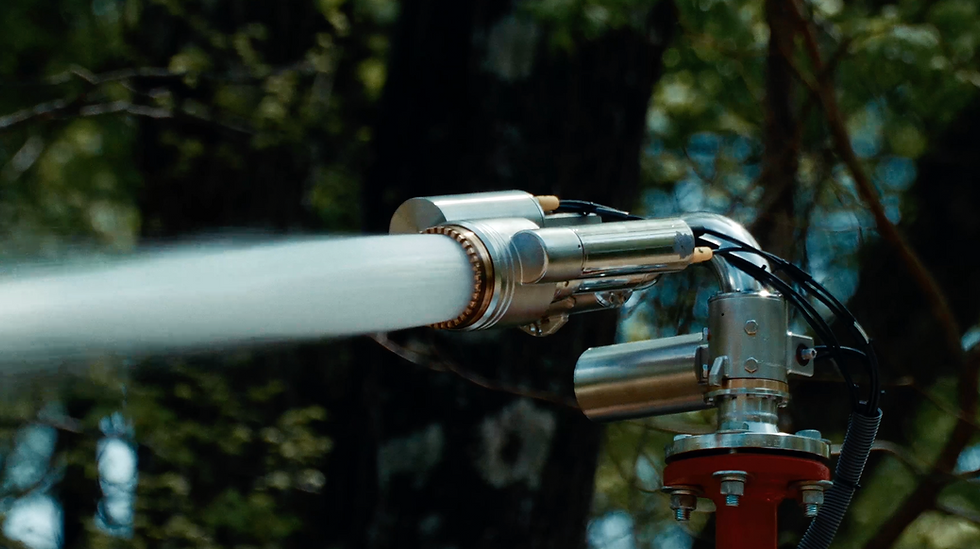
An Autonomous Robotic Fire Suppression System does not wait for heat to accumulate at the ceiling. WatchDog Robotics' NozzleBot monitors the protected volume continuously using triple-infrared flame detectors and thermal video analytics. When a flame signature is detected, the system calculates a three-dimensional position for the fire, aims a precision robotic nozzle, and initiates suppression. Detection to water on target: 7 to 9 seconds. Detection to fire extinguished: typically 12 to 15 seconds.
In the Ontario scenario, an ARFSS would have responded to the first ignition within seconds, while the fire was still confined to a single pallet. As the suspect moved through the facility setting additional fires, each new ignition would have been detected and addressed in the same timeframe. The system does not require human notification, alarm handoffs, or fire department response.
The result is not a suppression system "winning" against an arsonist. It is each ignition remaining small enough to be controlled before it contributes to the cascading fuel load that overwhelmed the building's fixed defenses. The difference between a contained pallet fire and a six-alarm total loss is measured in minutes. ARFSS compresses that interval to seconds.
| Traditional Sprinkler | ARFSS (NozzleBot) |
Detection trigger | Heat at ceiling; 135-165°F threshold | IR/thermal flame detection; 4-5 seconds |
Water on target | 2-5 minutes from ignition | 7-9 seconds from ignition |
Fire extinguished | Variable; often partial suppression | Typically 12-15 seconds |
Shutoff | Manual valve; runs until closed | Automatic upon confirmed knockdown |
Multiple ignition points | Each zone requires independent heat buildup | Scans and responds across all zones |
These response times are not theoretical. Independent testing by the Naval Research Laboratory and Jensen Hughes confirmed suppression of large Class A pallet fires in under 20 seconds. RISE Research Institutes of Sweden and Thomas Bell-Wright International testing documented detection in under 10 seconds, water delivery at 12 seconds, and structural damage below 10 percent across more than 60 facade fire scenarios.
The Secondary Cost: Water Damage Beyond the Fire
Conventional sprinkler systems run until manually shut off at the supply valve. In a developing warehouse fire, that may take hours. ARFSS monitors the fire in real time and closes the valve automatically when detectors confirm knockdown. The total water volume applied is a fraction of what overhead area-discharge systems release.
For distribution centers, the collateral water damage to unaffected inventory can represent a substantial portion of total insured loss. For manufacturing facilities with electrical control systems, motor control centers, or precision equipment, overhead water discharge introduces a second loss category that extends downtime well beyond the fire event itself. Post-suppression cleanup and electrical restoration routinely exceed the cost of direct fire damage in events where conventional systems activate late and run long. Targeted suppression changes that calculus.
The Case for a Middle Layer
The Ontario fire will be analyzed in insurance and fire protection literature as a major arson event with supply chain consequences across a densely populated market. It should also be read as a direct illustration of the response window problem: the interval between first ignition and effective suppression that determines whether an event is contained or catastrophic.
The building had sprinklers. The building was a total loss. Those two facts are not contradictory. They are consistent with what fire protection data has shown repeatedly in large, high-fuel-load environments. Ceiling-level heat-activated suppression is a necessary component of any protection strategy. It is not sufficient, on its own, to defend against fast-developing events in high fire load facilities.
ARFSS is the layer between first ignition and conventional suppression activation. That interval, in Ontario, was wide enough to destroy a 1.2-million-square-foot facility and remove hundreds of millions of dollars of consumer goods inventory from a regional market. In manufacturing and distribution environments where fire load is high and response time is decisive, closing that interval is the engineering problem worth solving.
WatchDog Robotics, LLC
PO Box 399, Jackson, WY 83001 | 307-231-0416 | watchdogrobotics.com


Comments